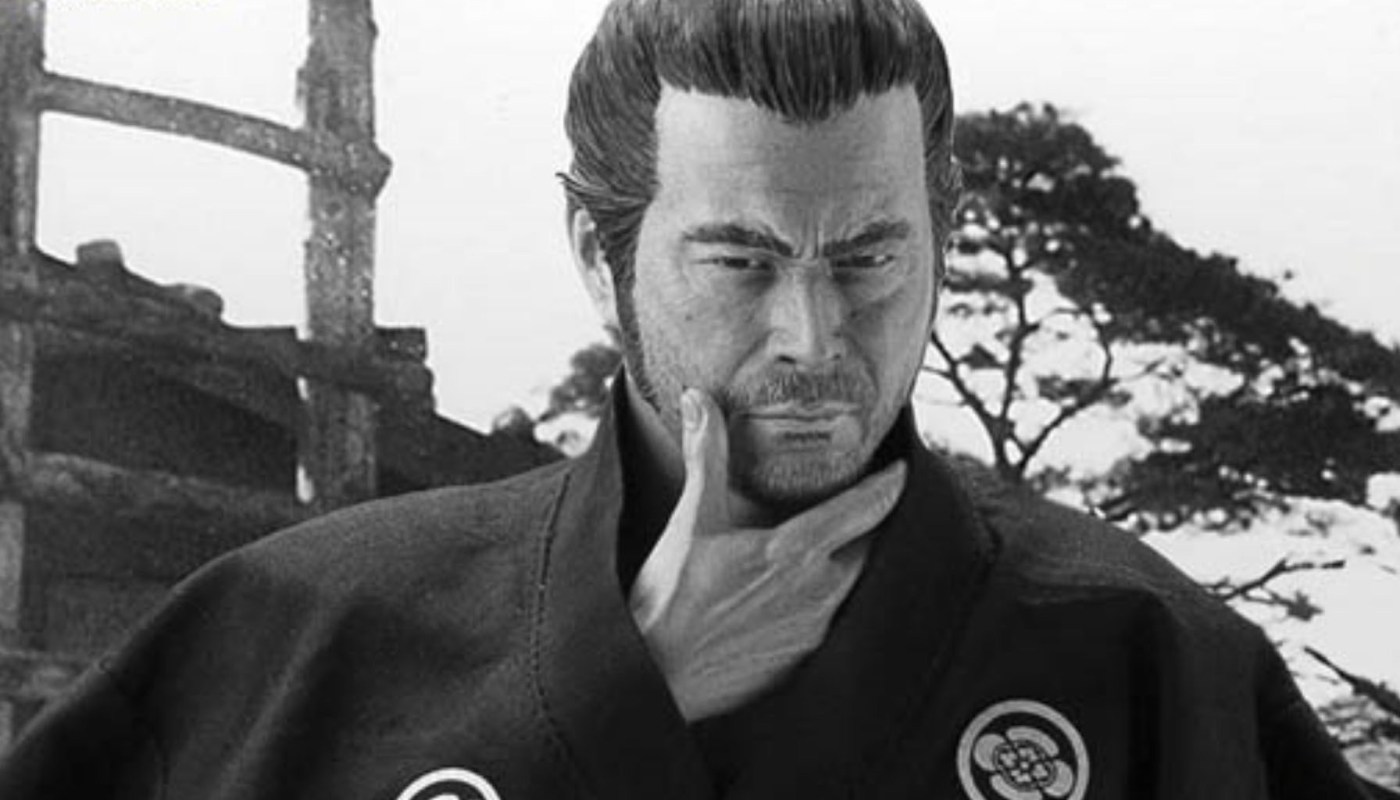
There’s a figure on my shelf who doesn’t need an elaborate pose or a flashy backdrop. He stands still, eyes forward, hand hovering just above the hilt of his katana.
He’s not from a galaxy far, far away.
He doesn’t wear a poncho or a helmet.
He’s the one they all learned from.
Toshiro Mifune is the blueprint for the modern antihero. And thanks to Kaustic Plastics’ 1/6 Scale Ronin figure, the legend now has a physical presence on my Detolf shelf—and man, does he own it.
But before we get into the figure, let’s talk about the man himself—and why he still matters.
Who Was Toshiro Mifune?
Toshiro Mifune wasn’t just one of Japan’s greatest actors—he was cinema’s greatest warrior. Throughout the 1950s and ‘60s, he worked closely with director Akira Kurosawa to craft a new kind of screen presence: physical, commanding, brooding, yet fiercely intelligent.
From Seven Samurai to Throne of Blood, Rashomon to Red Beard, Mifune made quiet defiance iconic. But it was 1961’s Yojimbo that turned him into something mythic.
In Yojimbo, Mifune plays a nameless ronin who walks into a corrupt town and proceeds to manipulate two rival gangs against each other. When asked for his name, he casually replies “Sanjuro,” meaning “thirty-year-old mulberry field.” It’s a throwaway lie—because he doesn’t need a name.
That character—the stoic, sarcastic swordsman with a hidden moral compass—became the template for the modern antihero.
The DNA of Every Antihero You Love
Sergio Leone saw Yojimbo and thought: what if this guy had a revolver instead of a katana?
Enter Clint Eastwood’s Man with No Name in A Fistful of Dollars—a direct remake of Yojimbo.
And from there, the archetype spread.
You can feel Mifune’s influence in characters like Han Solo, the rogue who masks honor behind bravado. In Snake Plissken, the cynical savior who doesn’t play by anyone’s rules. In Mad Max, the trauma-scarred drifter who helps from the fringes. Even Kwai Chang Caine from Kung Fu walks the ronin’s path—wandering, fighting only when necessary, and guided by a personal code.
These were the first wave of cinematic lone wolves. The second wave—The Mandalorian, Batman’s ninja phase, and yes, even John Wick—are just modern echoes of the path Mifune carved decades ago.
Personal Reflections
For me, discovering Mifune was like tracing the roots of my entire cinematic taste.
All those characters I loved growing up? The ones that felt like rebels with meaning?
Turns out, they all had the same cinematic ancestor.
As a Gen-Xer, I grew up admiring outlaws with honor—and when I found Mifune, I realized I’d been watching echoes of him my whole life.
So yeah… when I saw Kaustic Plastics was releasing a sixth scale figure of Mifune’s Ronin from Yojimbo?
That was an instant pre-order.
Figure Breakdown: Kaustic Plastics 1/6 Scale Ronin (Toshiro Mifune)
Character:
Nameless Ronin (inspired by Yojimbo, 1961)
Manufacturer:
Kaustic Plastics
Scale:
1/6 (~12 inches)
Retail Price:
$180–$210 USD (depending on version)
What’s in the Box
• Hyper-detailed Mifune head sculpt with topknot
• KP04 male body with full articulation
• Black and gray layered kimono with obi belt
• Traditional hakama pants and sandals
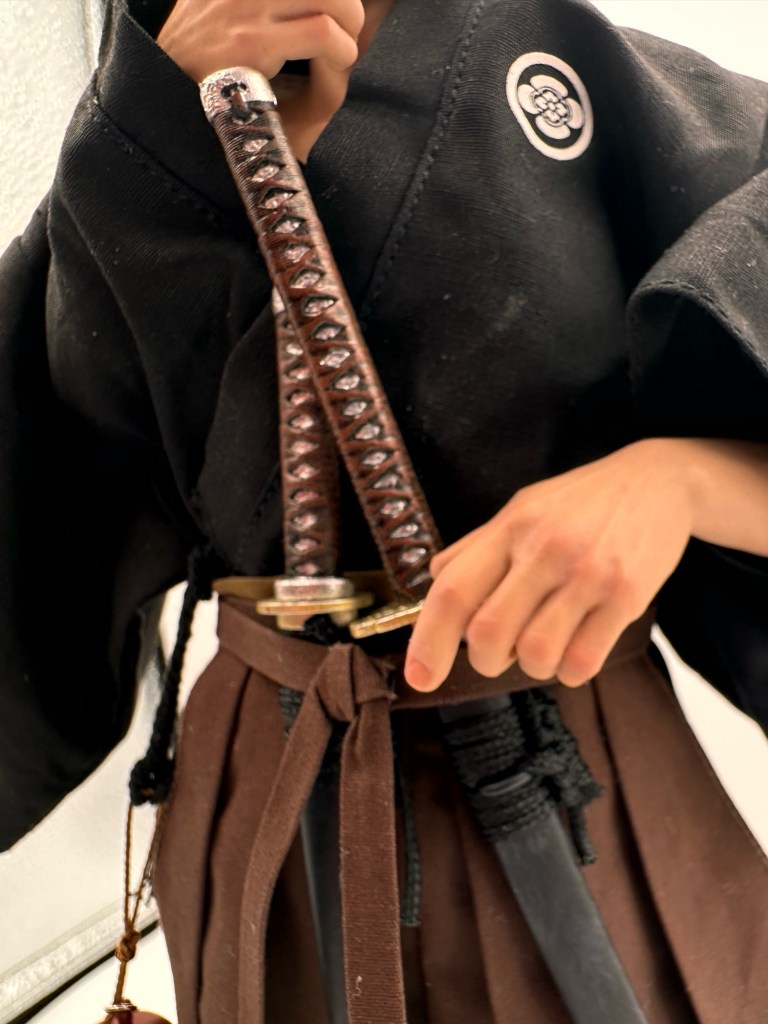
• Katana (with sheath)
• Sake bottle and cup
• Interchangeable hands (grip, relaxed, gesture)
• Display stand (some with kanji baseplate)
The Sculpt
This is the real standout.
The head sculpt is stunning—they nailed Mifune’s distinct features: that intense gaze, that ever-present frown that hints at both judgment and weariness. He looks alive. Not stylized. Not “inspired by.” It’s Mifune.
The sculpt even captures his subtle asymmetry. From every angle, you can see that legendary shrug about to happen.
Tailoring & Costume
The kimono and hakama are beautifully tailored. Fabric drapes naturally, and there’s no puffiness or awkward bulk. The obi belt is tight but flexible for posing, and the material feels authentic.
Even the sandals are accurate, though I found the foot straps a little delicate—pose with care.
The clothing also allows for a full range of motion, which isn’t always a given with layered outfits like this.
Articulation & Posing
Built on the Kaustic KP04 body, the articulation is excellent. Double-jointed elbows, full torso twist, and enough flexibility to pull off sword-drawing stances or just relaxed, slouchy ronin poses.
His balance is solid, and the hands swap out easily for different moods—combat-ready or sake-sipping contemplative.
Accessories
No gimmicks here. Everything included feels essential to the character:
• A katana and sheath that fits snugly
• Interchangeable hands for action or display
• A sake bottle and cup—perfect for capturing those in-between moments from Yojimbo
This isn’t a toy box—it’s a toolkit for storytelling.
Shelf Presence
This figure doesn’t shout. It doesn’t need to.
It owns space by standing still and daring others to blink first.
I’ve placed mine in the center of a “Lone Heroes” display—Clint Eastwood, John Wick, Han Solo, The Mandalorian. But Mifune’s Ronin sits in the center, because let’s be honest:
He’s the source code.
Final Thoughts
Sculpt: 10/10
Outfit: 9/10
Accessories: 8.5/10
Articulation: 9/10
Presence: 11/10
Overall: 9.5/10 – One of the most meaningful additions to my collection. Not just because of the figure itself, but because of what it represents. If you care about cinema, antiheroes, or the history of cool—this is a must.
Legacy in Plastic and Celluloid
The Kaustic Plastics Mifune figure doesn’t just honor a character—it honors a movement.
This is for the lone wanderers, the quiet rebels, the honorable outcasts.
This is for those of us who saw ourselves in the shadows of heroes who didn’t need to say much to say everything.
Toshiro Mifune was the first.
And now, finally, he has a figure worthy of that legacy.


Discover more from Genex Geek
Subscribe to get the latest posts sent to your email.
 Genex Geek
Comment like it’s a middle school slam book, but nicer.