Why Gen X Parents Say “I Love You”, Possibly Too Much – and Still Feel Like They’re Doing It Wrong
Before we were parents, we were survivors.
We let ourselves in after school, made our own snacks, and watched the afternoon fade into reruns. Nobody asked us how our day went. The only hugs came during funerals or airport greetings. And “I love you”? Like the plastic still on the couch or the busted remote with a rubber band, you didn’t ask about it. It just existed. Probably.
Probably.
Now we’re the ones parenting. And we’re doing it with a kind of frantic tenderness, like we’re trying to make up for a ghost that never hugged us back.
The Love Was in the Lunchbox
Our parents, mostly Boomers and the tail end of the Silent Generation, didn’t do “feelings.”
They did bills. They did silence. They did “you got food, don’t you?”
They managed chaos with tired eyes and short fuses. Some worked. Some didn’t.
Some just endured. They survived their own broken homes and passed down whatever scraps of stability they had left.
They gave us what they could. Sometimes that looked like a roof.
Sometimes it looked like a can of Chef Boyardee and a quarter for the bodega. A “quarter water” juice if you were lucky.
And for a lot of us, that was love.
A peanut butter sandwich with the crusts cut off. A pair of Skippies that got roasted on the playground.
Love in a form that didn’t involve eye contact or emotional validation; but hey, shoes are shoes, right?
Toys Were the Economy of Love
In my house, love didn’t come in words, it came in things.
Plastic. Boxed. Saved up for.
Toys became the economy of love.
My mother didn’t say “I love you”, she showed it in the way she scraped together money for Christmas. The “Christmas Club” savings account. The layaways. The way she’d start planning in July to afford December. That was her version of affection: sacrifice by installment.
And look, I loved those toys. They were magic. They felt like proof that someone had thought of me, even if they didn’t say it out loud. But I would’ve traded every Kenner figure for a few more hugs. Or a “How are you?” Or even just a moment of emotional safety that didn’t have a price tag.
Maybe that’s why, to this day:
• I measure my worth by what I can provide.
• I confuse giving with connecting.
• And I collect nostalgia like it might somehow fill the space that affection never did.
Because somewhere along the line, I learned that love came with a receipt. That sacrifice was currency. That effort counted, even if connection never landed.
Raised by Syndication
We didn’t learn emotional literacy at home; we got it from the screen.
Mr. Rogers told us we were special. Jason Seaver modeled apologies. Danny Tanner cried on camera. Uncle Phil held it down like a surrogate dad for a whole generation.
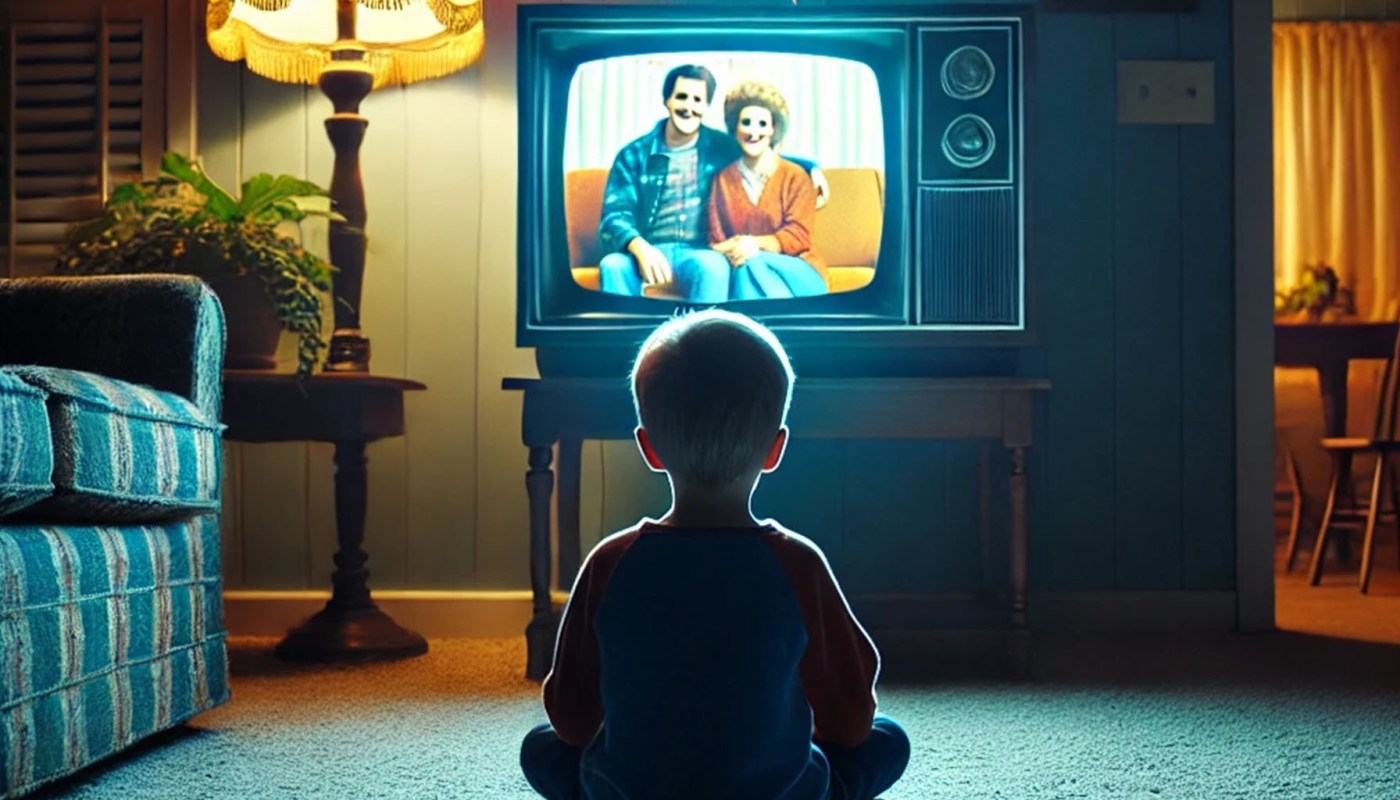
Our homes weren’t loud with chaos, they were quiet with absence. The kind of quiet that hums with distance. The TV wasn’t just background noise, it was the only voice talking to us.
Television raised us gently. It showed us what warmth looked like. What apologies sounded like. What emotional presence could be.
And sometimes, it got real.
I remember the Fresh Prince episode where Will’s dad bails on him, again. And Uncle Phil just steps in and holds him while he breaks down.
“It’s not your fault.”
No one ever said that to me, not at home, not in real life. But that line stuck. It felt like it was meant for me.
And then there was Mr. Rogers. Quiet. Steady. Present.
He’d look into the camera like he knew we were alone and say we were okay, just as we were. I didn’t always believe him. But I wanted to.
TV didn’t just entertain us. It filled in the emotional blanks.
Eventually, the culture caught on.
There was that HBO show Dream On, where a man’s inner life was built out of the TV clips he’d absorbed as a kid.
It was meant as satire. But for a lot of us, it was basically a documentary.
Or The Cable Guy Jim Carrey’s character says:
“I learned the facts of life from watching The Facts of Life.”
We didn’t get life lessons from our parents.
We got them from reruns, from very special episodes, from PBS monologues and laugh-track breakdowns.
And while I was watching sitcoms to feel connection, my mother was watching novelas for the same reason.
We were in the same apartment, different rooms, both seeking warmth from glowing boxes and cathode rays.
Just not from each other.
Personal Interlude: My Mother the Stranger
I can remember exactly one time my mother told me she loved me. One. It came out of nowhere, and it never happened again.
My parents slept in separate beds. I usually slept with my dad – we were tight. He had a scar on his belly from when he’d been stabbed, and he used to joke that I came from that scar.
That I came from him.
That I was more his kid than my mom’s.
We were that bonded.
Then one morning, I woke up and it was my mother lying next to me. She gave me a hug. She told me she loved me.
That moment is burned into my brain like a flashbulb in a dark room. Not because it was traumatic – because it was so out of character, it didn’t seem real.
And when it happened, I froze. I didn’t know what to say. Didn’t know how to respond. I was a kid handed something sacred with no idea how to hold it.
I knew it was big. I could feel the weight of it.
But I didn’t know where to put it.
I didn’t know how to process it.
I didn’t even know if I was allowed to believe it.
I never got another moment like that. And I still don’t know what to do with the one I got.
What We Got, and What We Gave Back
My relationship with my mom went from strained to non-existent. There was no bond, no warmth, no ritual beyond survival. She wasn’t a vile woman, just distant. Cold. She showed affection through things, not through presence.
But during my teen years, the distance became something darker. That’s when the real deterioration set in.
We both had black tempers.
She lashed out with actions. I lashed back with words.
And words became my knives.
Morning fights about school turned vicious. I hated being there. She hated that I wouldn’t go. Every day felt like war before 9 a.m. And though I didn’t realize it then, that time, that stretch of scorched earth between us, might have been the moment the bond broke completely.
Even now, I fear that part of me is still there. That part of her is still in me. And when I see my own kid struggling, with school, with mornings, with emotion, I worry. I worry I passed down something sharp. Something neither of us asked for.
When I moved out of New York, I stopped visiting. It felt like going through the motions of a relationship that never existed.
Obligation without connection is just guilt in a mask.
And if they never reached for you, why are you the one expected to reach back?
Success Without Witness
As an adult, I’ve tasted a little success. Not much, but enough to know what pride might feel like, if anyone had ever mirrored it back.
But that’s the thing. When no one’s watching your climb, success feels strangely hollow. Like you’re achieving in a vacuum. No “I’m proud of you.” No “Look how far you’ve come.” Just silence, like always.
Even as a kid, I was the “nerd.” Always in the “gifted class.” But gifted didn’t mean supported. It meant your A was expected—and anything less was failure. You didn’t get celebrated. You got measured.
My mom never came to school events. Never sat through a play. Never met a teacher. Never helped with homework. I don’t think she even knew how to engage with that world. Academics weren’t part of her life. Work success wasn’t either. That whole world, the one I was trying to grow into, was foreign to her.
And maybe that’s the saddest part.
I never really could find what it was her measure of a person.
So now, even when I accomplish something, when I hit a goal, land a role, create something I’m proud of, it still feels like I’m a kid bringing home a trophy to an empty apartment. Hoping someone will notice. Knowing they won’t.
What We Missed, and What We Found Too Late
Years later, long after the chaos of childhood, my brother and I had my dad over to the apartment. He had been mostly absent growing up, but that night… that night, we saw everything we’d been missing.
He was warm. Open. Funny as hell.
His laugh could fill a room. He told stories. Asked questions. Made you feel like you mattered. He was the kind of man we’d needed when we were kids.
And it was beautiful.
And it broke our hearts.
Because in seeing all he was, we were forced to reckon with everything he hadn’t been there for.
At one point, he got quiet. He told us, gently, that one of the reasons he’d strayed was because he had needed warmth, too.
Not as an excuse. Just as an explanation. A broken man looking for something he didn’t know how to name.
And it made something click.
None of us had been taught how to give love the right way. We’d just… scrambled for it. In the dark.
Some of us ran. Some shut down. Some turned into ghosts.
But all of us were cold, in our own way.
One Last Thing About Her
I don’t hold any ill will toward my mother. I’m not angry. Just… saddened. Saddened by what wasn’t there. By the bond that never formed. By the fact that so many people from her generation seemed emotionally disconnected from their children and maybe from themselves, too.
She’s older now. The kind of older that makes you think about death. And sometimes I wonder if I should reach out. Try to build something. Form a bond this late in the game, just so I can mourn it properly when she’s gone.
But I don’t.
Because the truth is – I find it horribly difficult. I’m anxious. I don’t know how to sit in that kind of space without breaking apart.
And if I try now, would it even be real? Or would it just be a performance, with grief already waiting in the wings?
So I do nothing. I freeze. And I know, I know, I’ll regret that someday. But I choose inaction anyway.
It’s the one thing I inherited that still fits too well.
The Ray, Not the Line
Instead, I pour myself into the bonds I can build. The ones I’m still in the middle of. The ones that matter right now.
I think of family like a geometric ray.
You remember those from school – how a line had arrows at both ends?
Infinite in both directions.
Past and future.
But a ray starts somewhere.
A single point.
And from there, it only moves forward.
That’s me.
That’s this.
The past doesn’t stretch behind me the way it does for some.
There’s no legacy.
No blueprint.
Just a beginning.
But forward?
Forward, I’ve got a shot.
If I can love better – louder, clearer, warmer –
Maybe the line keeps going.
Maybe my kid never has to rebuild from scratch.
Maybe the next branch of the family doesn’t grow out of damage…
But out of choice.
One More Thing
I say “I love you” a lot now. Probably too much. I try to spoil my family with affection the way I was spoiled with toys—except I want the words to stick.
But here’s the truth:
Sometimes I still treat love like currency.
And when it feels unappreciated, when I don’t hear it back, or it lands with a shrug, it hits harder than I want it to.
It makes me feel invisible. Unwanted. Like I’m failing at the one thing I swore I’d do differently.
Because even now, part of me still thinks love has to be earned. And that’s a hard habit to unlearn.
And sometimes, when my kid talks back, when I feel that old fire rising, I hear myself.
And worse, I hear her.
And I try to do better. To break it before it spreads.
Sometimes it works. Often it doesn’t.
It’s all a learning process.
Bracelets
I treat my kid like a friend. We joke. We hang. We laugh, God, we laugh. I tell her I love her, and she tells me the same. We trade bits, we trade barbs. We make fun of each other. We watch dumb shows. We talk.

I don’t know if I’m doing it right. But I try. I show up. I say it. I try and say it a lot.
Wish it were easier.
We have these matching bracelets.
Mine say “I hate you.”
Hers says “I hate you more.”
That’s our love language.
And that’s enough.
For now.
Until she tells her kid “I love you”, and means it without needing a joke to soften it.
And in a house where I was raised by ghosts, I like knowing she’ll remember the warmth.
Discover more from Genex Geek
Subscribe to get the latest posts sent to your email.
 Genex Geek
Comment like it’s a middle school slam book, but nicer.