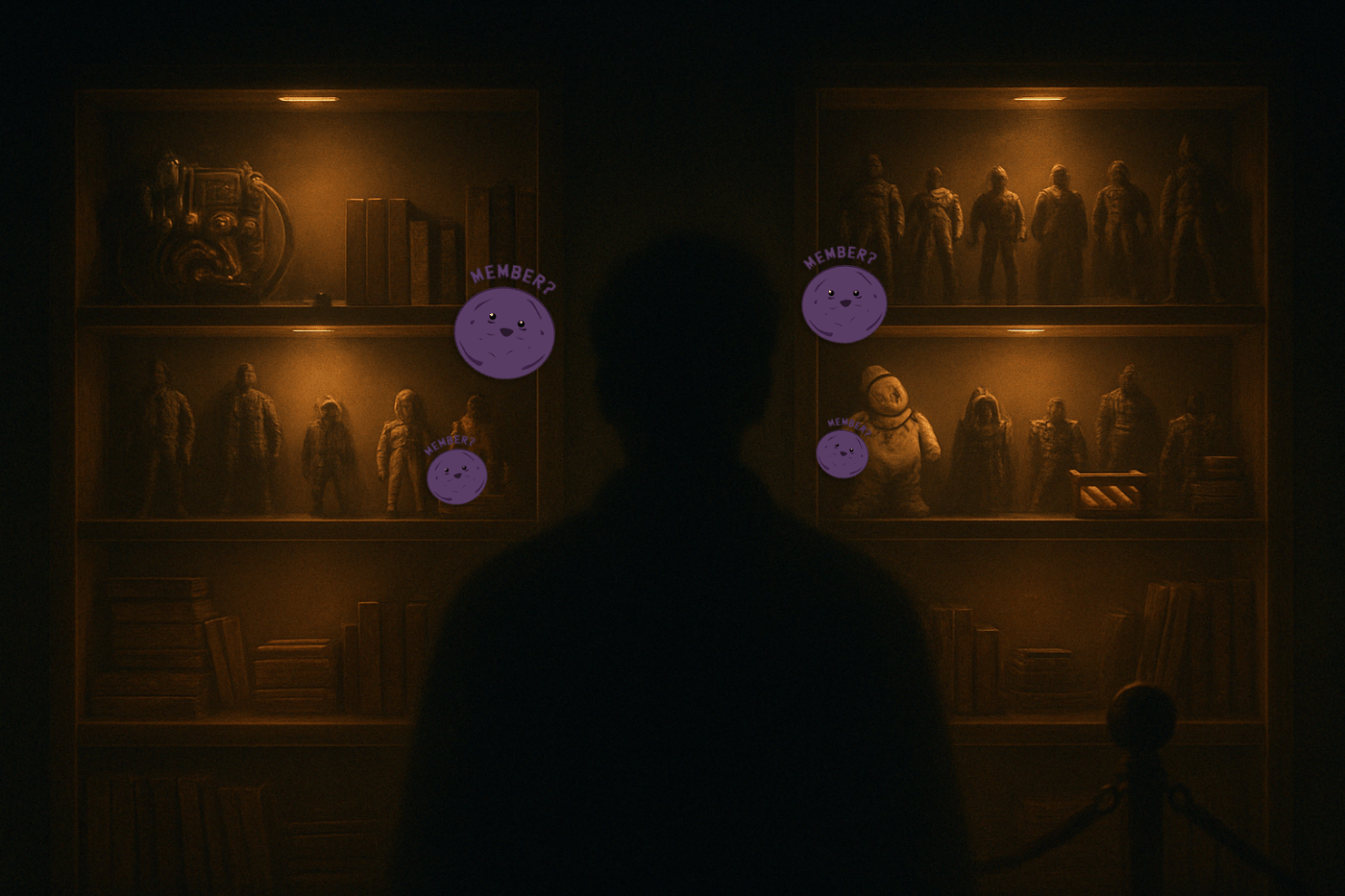

In 2016, South Park dropped one of its sharpest metaphors: the Member Berries. These talking grape-like creatures whispered pop culture catchphrases straight into our dopamine centers:
“Member Chewbacca?” “Ooh, I ‘member!”
It felt harmless—funny even. But then came the pivot:
” ‘Member when marriage was just between a man and a woman?”
Suddenly, the sweetness turned sour. The joke had teeth.
Across Season 20, the Member Berries weren’t just callbacks. They were a virus. They influenced politics (electing Mr. Garrison-as-Trump), warped entertainment (pressuring J.J. Abrams to reboot everything), and hypnotized the public into craving an idealized past that never truly existed.
The message from Parker and Stone (Creators of South Park) was clear:
Nostalgia isn’t neutral. It can sedate you. Regress you. Be weaponized by the very forces that ruined the thing you’re remembering.
It was brilliant.
But it also hit too close.
Because I, too, live among the berries.
Chapter Two: Welcome to My Berry Patch
I’m a Gen Xer. I was raised by cartoons, calmed by sitcoms, and baptized in the glow of CRT static. My present? It’s a curated shrine to that past.
Sixth-scale figures. Custom-painted 3D prints. Ghostbusters props. A fully-wired proton pack with lights and smoke. Horror masks. Comics. Blu-rays. Arcade builds. My home is not just a living space—it’s a cathedral of memory.
South Park might say I’m numbing myself. That I’m trapped in yesterday.
But I don’t see nostalgia as retreat.
I see it as ritual.
Chapter Three: The First Berry Was Plastic

When I left Puerto Rico at eight, I left everything behind: big G.I. Joes, Mego superheroes, a two-parent home. I arrived in the Bronx with no toys, no English, and no real understanding of what had just happened.
A small Kenner figure. My first Star Wars toy. I hadn’t even seen the movie. But I held him like a lifeline. He fit in my hand and in my new apartment—small, scaled-down, weird.
He wasn’t nostalgia. He was survival.
That’s what so many people miss. The artifacts we cling to? They aren’t distractions. They’re anchors. Each one remembers for us. Each one proves we made it this far.
Chapter Four: Altars and Armor
I believe in altars. Not the religious kind. The emotional kind.
We’ve lost rituals in this culture. We no longer have sacred places to gather meaning, to center ourselves. Religion used to provide that. Temples, icons, altars—they gave people somewhere to lay their burdens, somewhere to connect to something larger than themselves. We’ve stripped those spaces out of public life, but the need didn’t vanish. We’re social creatures. We crave ceremony. We crave objects that hold memory.

And we crave artifacts.
Think of the Shroud of Turin. The Holy Grail. The blood of San Gennaro. People are drawn to these objects not just because of belief, but because they are tangible. They make myths feel real. They let people touch the story.
My artifacts are plastic—but they function the same way.
When I pick up a PKE meter or slide open the ghost trap, I’m not just playing. I’m connecting. To cinematic moments. To heroes. To versions of myself I thought I’d lost.
Every shelf I build is a shrine. Ghostbusters. Horror. Batman. Star Wars. These aren’t collections. They’re evidence. Evidence that I felt joy. That I built something when everything else felt like collapse.
And when I suit up as a Ghostbuster—proton pack lit, ghost trap venting smoke—I’m not a guy drowning in bills and midlife dread. I’m a hero. A star. Kids gather. Strangers smile. For a few hours, I am who eight-year-old me needed to see.
Then I go home. Take it all off. And I’m back to stress, survival, uncertainty.
But the altar remains.
And I go to it when I need strength.
Chapter Five: The Curator of a Vanished Era
All of Gen X is curating a life that no longer exists.
There’s more behind us than ahead. The past is where the prettier version of me lives. Where the music was better. The girls smiled wider. The stakes felt simpler.
My future? It’s insurance premiums. It’s watching my daughter fight battles I can’t shield her from. It’s hoping the structure doesn’t collapse before I can pass her something worth keeping.
Even parenting is a nostalgic act. You raise a child on the ghosts of your values. You share rituals and reruns. You say, “This helped me. Maybe it will help you.”
My daughter doesn’t need to ask about my childhood. She sees it. In the smoke of the ghost trap. In the yellowing comics. In the shelves.
I’m not a mystery.
I bring evidence.
Chapter Six: My Name Is “Genex”
In Ray Bradbury’s Fahrenheit 451, published in 1953, the world burned its books to keep people compliant, thoughtless, obedient. Ideas were dangerous. Stories were subversive. Knowledge had to be erased to keep the peace.
But those who resisted found another way.
A secret underground of men and women committed themselves to memorizing entire texts—line by line, breath by breath. One became Shakespeare. Another, Plato. They carried entire civilizations in their minds, preserving the DNA of culture so that it could be rebuilt after the fire.
It wasn’t just survival. It was resistance. It was sacred.
That story stayed with me – not just because of what they remembered, but because of what they refused to let die.
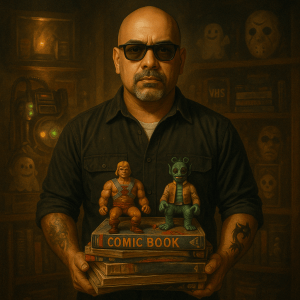
Me? I’m not Shakespeare.
I’d like to think I’d go by Genex.
I am the record of Saturday morning. Of Atari bleeps and horror aisles. Of bargain-bin toys and complicated grief. Of latchkey wisdom and analog joy.
I don’t hoard. I archive.
I don’t escape. I preserve.
Because in a world that forgets fast and sells faster, I remember slowly. Carefully. Loudly.
I don’t just collect plastic. I carry a myth.
And maybe one day, when the reboots collapse and the servers go dark, someone will ask what it used to feel like to be a weird, wounded, wonderful kid in the 80s.
And I’ll still remember.—
Chapter Seven: Are the Berries Poison?
Sometimes.
When nostalgia becomes avoidance, it dulls you. When it makes you fear the present, it controls you. I’ve felt that. I’ve bought things I didn’t need, chasing a spark that never caught.
Here’s the thing about collecting—something I think people with other obsessions or addictions will understand: the high doesn’t last. It gets shorter with every new piece.

I walked into Comic Con wearing my Ghostbusters gear: hundreds of dollars in, countless hours spent soldering, programming LEDs, and modifying smoke effects in the proton pack. It should have been a triumphant moment. And for a while, it was. Kids smiled. I felt like a star, a hero, the main character in a life that usually treats me like an extra.
But then I saw other Ghostbusters. Better builds. Rare props. Tricks I didn’t have. Instead of connecting, I compared. I inventoried every missing element. And when I got home? That comparison haunted me. The high had faded before I even took the suit off.
So I got back to work. I scrolled eBay. I bookmarked tutorials. I fed the need to fix what no one else noticed was broken.
Collecting isn’t always celebration. Sometimes it’s filling a hole that you can’t quite patch any other way.
And then there’s the part that hurts in a different way—the legacy you can’t quite pass down.
My daughter doesn’t care about Star Wars. She won’t go near Trek. She won’t sit through old movies because “ugh, the effects are so bad.” She lives on TikTok, YouTube, Instagram—content in fast bursts, rarely finishing what she starts. No rewatches. No world-building. No Boba Fett fantasies where he beats up He-Man in a crossover battle only I could write.
Sometimes I look at her and think, My days are numbered. Not just biologically—but culturally. I know she’s her own person. I celebrate that. But I’d be lying if I said it didn’t sting when she turns away from the worlds that built me.
I wish she’d take more of me with her.
And that’s the warning South Park was really giving us with the Member Berries—not that nostalgia is bad, but that it’s a trap when consumed uncritically. That if we keep reaching backward without asking why, we’ll miss what’s here. What’s coming. What might be better.
But when nostalgia is handled with reverence? It becomes ritual. Medicine. Continuity.
The Member Berries in South Park were a warning. But warnings aren’t prophecies.
I still ‘member.
But I also rebuild. Repaint. Rewrite. Pass it on.
Because some of us weren’t just raised by pop culture.
We became its last priests.
And we’re still listening—still holding the light—
waiting to see who remembers us.
Discover more from Genex Geek
Subscribe to get the latest posts sent to your email.
 Genex Geek
Comment like it’s a middle school slam book, but nicer.