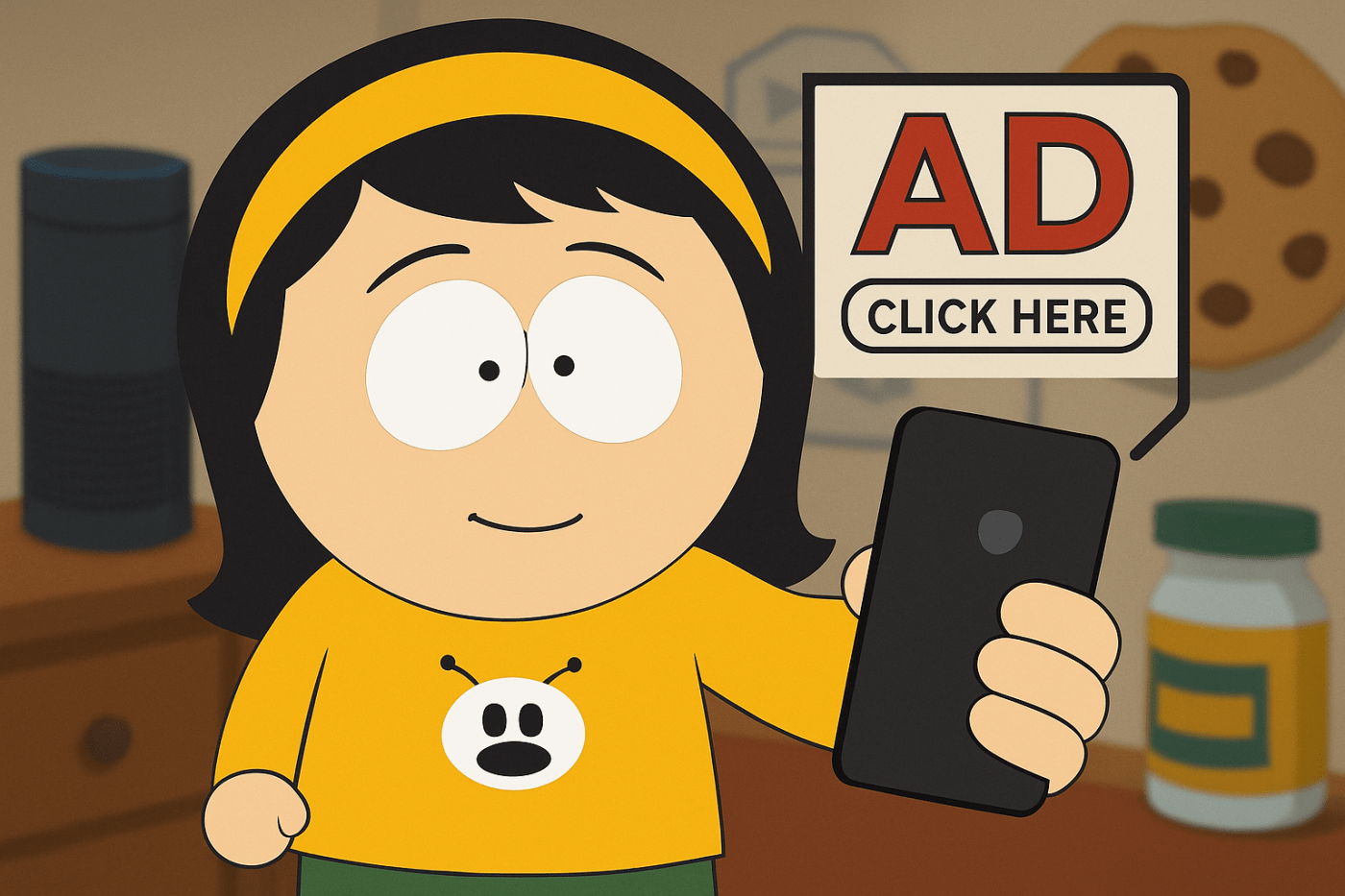
I’ve been trying to figure out how to explain the last twenty years of my career, and the only thing that makes sense is this: there’s a South Park arc that’s been stuck in my head. Season 19. The “Leslie is an ad” storyline.
A regular-looking girl at school turns out to be a self-aware native ad. Not a pop-up. Not a billboard. A person-shaped pitch with feelings, flirting, and a perfectly timed smile.
And nobody noticed.
Because the ad didn’t sell. It befriended.
Back in 2015 that felt like satire. Today it feels like a documentary. And it stings more for me, because I’ve spent twenty years as an ad product manager. I watched it happen from the inside. Helped build the pipes. Saw how the sausage was made, and then watched it crawl out of the factory and start dating my friends.
Gen X vs Ads: We Thought We Were Immune
Gen X grew up thinking we were immune to commercials.
We mocked jingles.
We fast-forwarded VHS tapes.
We drew dicks on Joe Camel.
We thought awareness was armor.
It wasn’t. It was bait.
We laughed at the Budweiser frogs, but they still lived in our heads. Joe Isuzu still sold cars by being a liar we remembered. We weren’t rebels. We were unpaid interns in Madison Avenue’s memory lab.
And then I crossed over to the other side. Not Mad Men. More like sad men, building dashboards and targeting tools to make sure the right beer ad hit the right guy at the right time. Turns out awareness doesn’t protect you when the ad doesn’t need to win your heart. It just needs your data.
The Floater Years
Back in the infancy of the web, I helped create one of those Frankenstein monsters we still complain about today. We called it a floater.
A branded mascot that would literally fly across your screen until you clicked him away. Not content. Not helpful. Just a character flapping over your browser like a drunk uncle who refuses to leave.

The first one I built was for Sony. Remember Plato? The blue alien with the bug eyes, meant to be your “friendly guide” to the internet? He looked like someone mashed up a Teletubby and a migraine aura. Sony wanted him to be their digital ambassador, and instead he became a pest.
So we made him float across your screen until you gave in and clicked him. And it worked. It sold big. Which meant we did it again. And again. Sour Gummy Bear. Green M&M. The Actual EMINEM! Other mascots. More floaters. More invasions.
And here’s the part I really regret: I even wrote a little script that made Plato dodge your mouse as you tried to click him away. Just enough to make it feel like a game of Whac-A-Mole. Adware with a sense of humor. Engagement through irritation. It was 2002 and I thought I was clever. Really, I was just handing people a migraine wrapped in JavaScript.
I still remember stumbling on a forum post where someone called Plato “the demon.” Another said their kid cried when the alien kept zipping away from the mouse. That was the first time it hit me – I wasn’t building fun little gimmicks. I was making digital pests. And I felt it in my gut.
And when that wasn’t enough, we went bigger. We started selling homepage takeovers. Skins that wrapped entire sites in a single ad, top to bottom, background to sidebar. Editorial, navigation, everything drowned in corporate colors. You’d log into a news site and instead of journalism, the whole page screamed about Spider-Man 2 or Mountain Dew Code Red.
At the time, I thought it was impact. What it really was, was selling out editorial integrity to make the homepage look like a billboard.
But here’s the thing: those were just dumb disturbances. They annoyed you, sure, but they didn’t know who you were. They weren’t targeting you as a person, slicing your life into data points and selling them off. They just shouted. I thought I was already playing dirty. Little did I know how deep it was going to go.
Ethan Zuckerman – the guy who invented the pop-up ad – eventually came out and apologized for his creation. He said, “I’m sorry. Our intentions were good.” He just wanted to separate ads from sketchy content. Instead, he unleashed one of the most hated formats in internet history.
I get it. I never issued a public apology, but I probably should have. Because every floater and homepage takeover I helped launch was another brick in the wall of distraction that turned the internet from a wild frontier into Times Square at midnight.
The Mics Are Always On
When we were kids, Big Brother was supposed to kick down your door. Turns out, we just bought him ourselves for $49.99 on Prime Day and stuck him in the kitchen.

This isn’t wiretapping. This is voluntary snitching. We used to whisper secrets to our friends. Now we shout them at Alexa.
“Hey Alexa, order toilet paper. The one the blue bears in the commercial like. No dingleberries! And by the way, here’s my entire family medical history.”
And the wildest part? Alexa doesn’t even give you the toilet paper you asked for. She gives you nineteen versions you didn’t want, a bidet washlet, and a squatty potty shaped like a unicorn. Because apparently my butthole is now an algorithm.
Sometimes I’ll catch myself talking to Alexa at 2am because no one else is awake. Which means somewhere out there, a database has me on record rambling about how I miss the taste of Dunkaroos. And then, boom, Instagram hits me with a Dunkaroos revival ad for twelve bucks a box.
And it’s not just Alexa. Her whole family’s in on it. Siri in your pocket. Gemini in your search bar. ChatGPT waiting for you to spill your guts at midnight about how you think you might be able to control radio waves if you really concentrate. They’re all ears, and none of them ever forget.
We didn’t just let the microphones in. We gave them our Wi-Fi password and taught them the kids’ birthdays.
The Consent Illusion
People love to say cookies are dead, privacy laws are saving us, GDPR is here to protect. What it really means is more pop-ups and banners.
Third-party cookies were the nosy neighbor peeking through the blinds. First-party cookies were your spouse checking your snack drawer. One had binoculars, the other had a key. Both were still snooping.
And the regulations? All they did was turn the snooping into paperwork. Endless pop-ups asking if I “consent.” I’ve clicked “Accept All” so many times I may have accidentally given joint custody of my daughter to a Slovenian yogurt company.
It’s not protection. It’s a smokescreen. A feel-good UI over the same hungry machine.
Basically, it’s the tech version of paper straws and no more free plastic bags.
Good intentions, pain-in-the-ass reality.
Building the Death Star (a.k.a. My Job Now)
Here’s the part where I admit I’m still in it. I’m not coding floaters anymore. These days I spend my time building user models. Figuring out who you are, what you care about, and then re-arranging the entire page so it feels like it was designed just for you.
Not just what ad you see – the whole layout. Headlines in a different order. Promos shifted around. It’s like a Choose Your Own Adventure book, except the adventure is “How fast can we get you to click on sneakers.”
And yes, we wrap it all in “consent.” GDPR buttons, cookie settings, preference centers. You can click “Manage Options” if you want. It’s right there, hiding behind a twelve-tab labyrinth that looks like the skill tree from Elden Ring.
I tell myself I’m doing it responsibly. That I’m navigating privacy protections, balancing user trust with business needs. But sometimes I look at what I’m building and think, “Oh God, I’ve basically become the Dungeon Master of capitalism.” Rolling D20s to see if your paycheck crits into another subscription.
The floaters annoyed you. The takeovers drowned you. This stuff? It studies you. It models you. It tries to predict what kind of person searches for “prostate health” and “Ghostbusters cosplay” in the same hour.
Spoiler: it’s me. (Shout out to the Swifties!) I’m the problem. It’s me.
And every once in a while, it nails me so perfectly it feels like I’ve been bugged. I was telling a buddy a story about my first action figure – a ragged little Star Wars Greedo that was my first Star Wars toy, and ten minutes later my feed was full of ads for vintage Greedo figures on eBay. Same cardback. Same blaster. It felt less like coincidence and more like the walls were listening. That’s when it hit me: the Death Star doesn’t just see you. It knows you.
And today, turning 54 (Happy Birthday to me), I feel like I’ve spent half my life helping to build it, and the other half trying not to get swallowed by it.
When the Ads Became People
Ads don’t sell anymore. They listen. They learn. They wait for you to be vulnerable.
They don’t just know you searched “hair loss treatment.” They know you searched it at 3am, on a Tuesday, after you zoomed in on your reflection too long. That’s not an ad anymore. That’s a short story. That’s a sales pitch that knows the exact flavor of your sadness.
And here’s the kicker: sometimes it works. Sometimes the ad really does feel like it understands me better than my friends.
Just last week, I was spiraling a little about turning fifty-four. Feeling old, invisible, like my best years were already boxed up with my VHS tapes. And right on cue, my feed serves me an ad for a pair of sneakers – the perfect color, the right brand, the exact kind of thing I would’ve bought in my twenties if I could’ve afforded them. And I bought them. For a second, I wasn’t just a mark. I was seen. And that’s what scared me the most. Because at 54, I should know better. And I still clicked “Buy Now.”
South Park warned us. Leslie was the beta. Now she’s in your feed, with better hair, an affiliate link, and a Klarna payment plan.
Discover more from Genex Geek
Subscribe to get the latest posts sent to your email.
 Genex Geek
Comment like it’s a middle school slam book, but nicer.