How a wordless cartoon cat taught us that not everything needs to be finished.
A World Half-Built

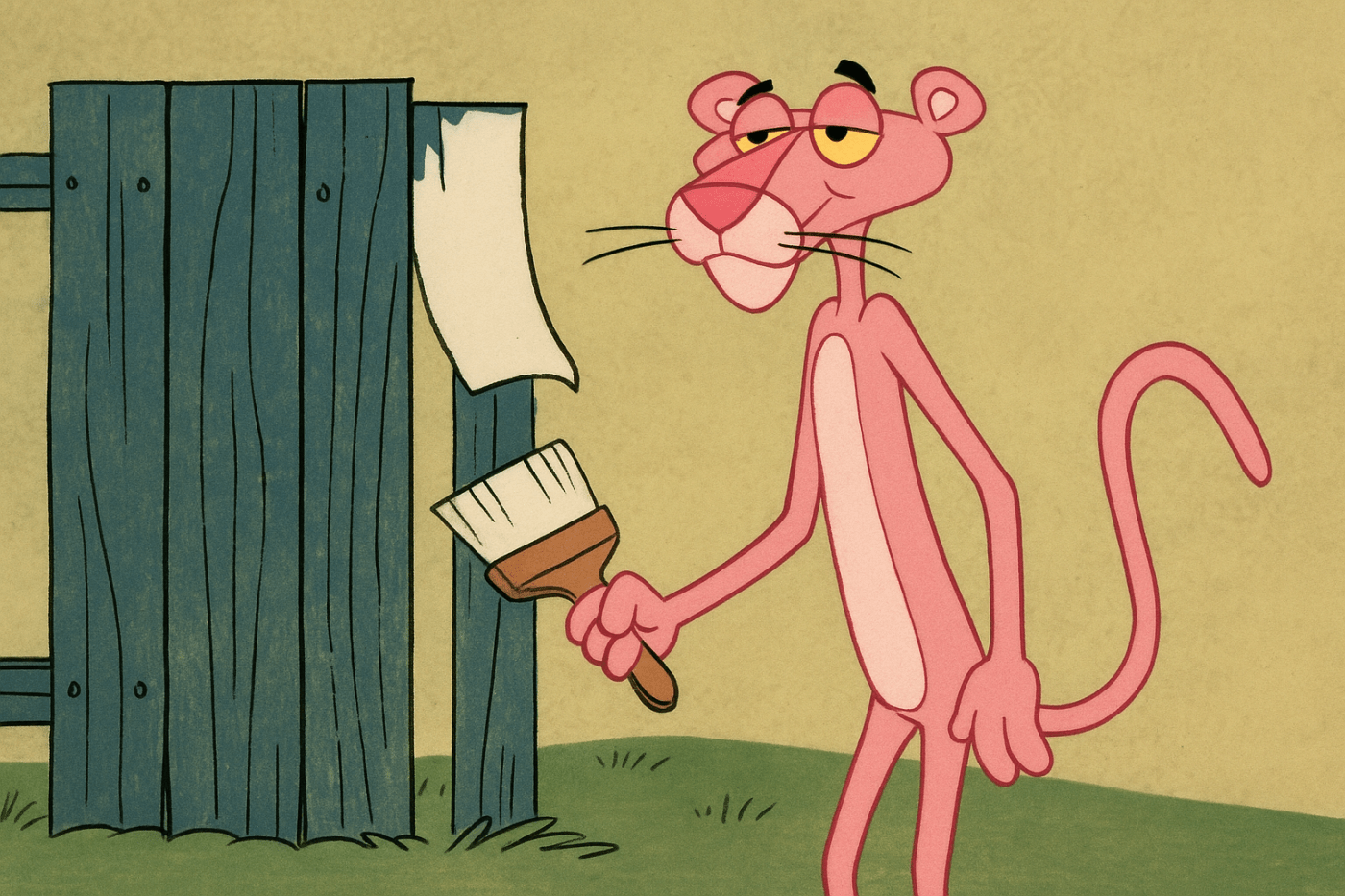
Imagine a world where a ladder leans against a wall that hasn’t finished becoming a house yet. The grass is painted on, curling at the edges like loose paper. A fence starts and ends without explanation, slumping slightly where nobody is watching. The sky is blue because somebody decided it should be. But not because it means anything.
Through it all, he walks.
Tall. Slender. Pink.
He doesn’t rush. He doesn’t ask permission. He moves like a saxophone solo – fluid, unhurried, existing for the sheer joy of motion.
Where he passes, walls peel; his touch causes paint to unravel… forgetting what it had been trying so hard to be. Where he lingers, reality hesitates, unsure if it wants to stay built after all.
He never says a word.
He doesn’t need to.
He doesn’t fight the world. He doesn’t break it.
He just… softens it.
Loosens its seams. Unmakes its walls with a single color, a sly glance, and the kind of effortless cool that never needed applause.
Somewhere behind him, a slow, sly saxophone chuckles. And the world, unfinished once again, sighs in relief.
Two Tricksters, Two Universes
Not every trickster needs noise.
Some, like Bugs Bunny, survive in the crowded, chaotic worlds they inherit. They bounce between opera houses, carrot patches, and battlefield trenches, wisecracking their way through the noise until it bends to their will.
I have always views Bugs Bunny as a Trickster God.
But he is the trickster of complexity. He knows the rules. He rewrites them as fast as they’re thrown at him. He wears a thousand faces — a matador, a Valkyrie, a cowboy — whatever it takes to stay one step ahead.
His world is messy, busy, overbuilt. And Bugs is its master improviser, its agent of controlled chaos.
But the Pink Panther isn’t like that.
He doesn’t inherit complexity. He doesn’t need a system to dance through. He doesn’t adapt to the noise, because there is no noise.
Pink walks through a different kind of world. Empty. Open. Unclaimed.
He doesn’t reshape a crowded universe. He gently refuses to let one be built around him.
No disguises. No speeches. No frantic shifts to stay ahead.
Where Bugs builds complexity into comedy, Pink quietly dismantles complexity before it can harden.
Where Bugs breaks the rules and makes a new system, Pink peels the rules away and leaves nothing but the unfinished hum of existence.
In that way, Pink isn’t a trickster in the classic sense. He’s something rarer. Something quieter. Something most mythologies never bothered to name.
Pink Panther is the trickster of benevolent entropy.
The one who smiles as ladders lean, as fences curl, as walls forget they were ever meant to stand.
Not out of cruelty. Not out of rebellion.
Out of mercy.
The Panther’s World: Only Two Forces
There are no crowds in the Pink Panther’s world. No armies. No citizens. No ticking clocks.
Just two forces, circling each other forever.
One wears a bowler hat. Short. Square. Always building.
The other? Tall. Slender. Pink.
One tries to hammer the world into a shape. The other brushes past him, leaving everything just a little more unfinished than before.
They don’t speak. They don’t trade insults. They don’t even seem angry most of the time.
The bowler-hatted man — sometimes a construction worker, sometimes a homeowner, sometimes just a man with a clipboard — hammers fences into the grass, paints walls blue, raises scaffolding toward a sky that barely remembers to be blue.
And Pink?
He smiles. He peels. He paints.
He lifts floorboards like rugs. He turns blue walls pink with a glance. He rearranges doors, windows, ladders, not to destroy them, but to remind them they didn’t have to stay where they were nailed down.
In “The Pink Phink” (1964), the Little Man paints a house blue, meticulously, section by section. Pink waits. Repaints. Not violently. Not even mischievously. Just… differently. Softly. And by the end, the whole house is pink again, and the builder is exhausted, not from war, but from resisting a force that never needed to fight.
In “The Pink Blueprint” (1966), the duel turns architectural. The Little Man’s house is angular, efficient, boxy. Pink replaces the plans with curves, circles, and pink flourishes. The house keeps rebuilding itself into something softer, stranger, and the Little Man can’t stop it. His structure is no match for Pink’s style. Logic loses to rhythm.
And in “Prefabricated Pink” (1969), Pink tries to help build a house. But help is the wrong word. As he joins a human construction crew, he dismantles the process, not deliberately, just by existing in the space. Hammers bend. Beams fall. Geometry warps. Not out of chaos, but because Pink doesn’t obey structure. He doesn’t reject it. He just doesn’t believe in it.
These aren’t battles. They’re refusals.
Pink doesn’t attack. He unfolds the world and shows it that it doesn’t need to be so rigid.
There is no final victory. No final collapse.
Just motion.
Just Pink, walking on. Just the world, sighing and shrugging and peeling behind him.
Benevolent Entropy: The Hard Truth Religions Avoid

Most stories worship the builders.
Gods who forge the world from clay and fire. Titans who raise mountains, carve rivers, shape continents. Heroes who lay down the first stones of cities.
Creation is seen as holy. Order is seen as good. Building is what saves the world.
But Pink knew better.
He knew, without ever saying a word, that building alone can trap you. That walls don’t just keep the cold out. They lock you in.
That sometimes, mercy isn’t another house or another fence.
Sometimes, mercy is a peeled wall. A painted door lifted from its hinges. A structure quietly forgotten before it becomes a cage.
Even in darker mythologies, the real horror isn’t chaos. It’s too much pattern.
In stranger dreams — the labyrinths of Leviathan — we see what happens when order becomes horror. Too many locks. Too many patterns. Too little freedom.
Pink didn’t fight that with fire. He didn’t tear the world down in rage.
He walked through it. Silent. Sly. And quietly unbuilt it just enough to keep it alive.
A ladder would sag. A fence would peel. A house would blush pink and crumble back into possibility.
Not war. Not rebellion.
Mercy.
Why It Mattered (And Still Does)
We didn’t know what we were learning when we watched him.
We thought it was funny, maybe. The way he peeled the world apart like old wallpaper. The way fences slumped and ladders sagged when he smiled at them. The way blue houses turned pink with barely a fight.
But go back and rewatch “The Pink Phink,” and notice how Pink wins without ever escalating. No bigger paintbrush. No clever trap. Just presence. Persistence. A paint can with no urgency. The house doesn’t just change color. It changes meaning. From control to expression. From structure to softness.
In “The Pink Blueprint,” you can feel the rhythm of reality breaking. Pink isn’t fighting the builder. He’s reminding the world that it could be different. That walls could curve. That houses could have whimsy. That life could be pink instead of just being built.
And in “Prefabricated Pink,” the illusion of progress crumbles under its own weight the moment Pink steps into the jobsite. Not because he’s careless, but because his very nature is incompatible with rigid systems. He doesn’t tear the house down. He just makes it impossible to finish.
That was the lesson we didn’t realize we were absorbing:
You don’t have to finish everything.
You don’t have to harden.
You can just be a soft force in a loud world — and that might be more powerful than noise ever was.
While other cartoons taught us to outwit, to outfight, to outshout, Pink taught us to walk through the walls without lifting a fist.
A Dash of Pink
The Little Man will always keep hammering. Walls will always go up. Blueprints will always be drawn.
That’s the way of the world.
But somewhere — if we’re lucky — there’s still a slender figure walking just out of sight. Still peeling. Still painting. Still refusing.
He doesn’t rage against the walls. He doesn’t scream at the builders. He doesn’t tear the blueprints apart in some violent, final act.
He just… smiles. Takes a brush. And leaves a mark that says,
You don’t have to stay this way.
Not everything needs to be finished. Not everything needs to stand forever.
Sometimes, the kindest thing a world can hear is the soft tearing sound of a wall peeling away. Sometimes, mercy wears a pink grin.
Sometimes, the future isn’t built. It’s left open. Waiting.
That’s the beauty of that show.
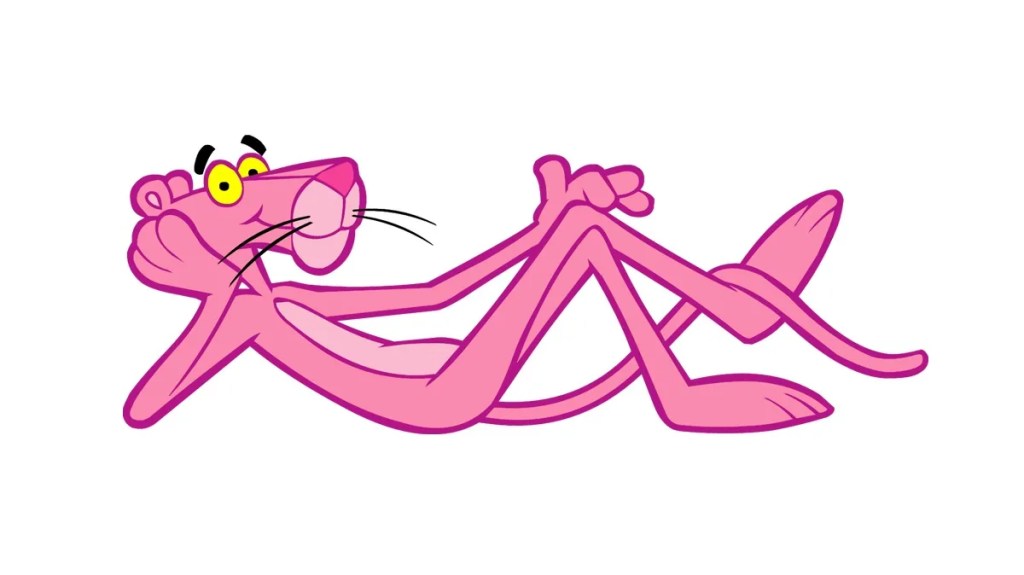
Simplicity. And a dash of pink.
Bugs wasn’t the only god we followed.
For every loud-mouthed rebel bending Saturday morning to his will, there was a quiet force peeling it all back.
The Pink Panther didn’t shout. He didn’t trick. He just refused.
And yet, he shaped the world in his own way — just like the others did.
You can meet his louder counterpart in Bugs Bunny: The Trickster God of Saturday Mornings,
and mourn the rest of the pantheon in They Raised Us Too: The Cartoon Gods We Lost.
Together, they didn’t just entertain us.
They taught us how to survive.
Discover more from Genex Geek
Subscribe to get the latest posts sent to your email.
 Genex Geek
Comment like it’s a middle school slam book, but nicer.