
I grew up in the Bronx in the mid to late 1980s, which means I spent most of my teenage years sweating, dodging, and carrying a boombox that weighed more than I did. It was loud, it was dirty, and everything smelled vaguely like piss, polyester, and hot pizza—but it was ours.
You didn’t just live in the Bronx—you navigated it. You learned to read body language fast. You knew which bodegas sold loosies, which payphones actually worked, and how to wedge your foot just right so the 6 train door didn’t close on your ass. And God help you if there was a Yankees game that day—because suddenly your ride home was full of drunk white dudes from Westchester yelling “DAAARyl!” like they invented the borough.

Alexander’s wasn’t just a department store. It was the Bronx’s living room.
Fordham Road was chaos—pure sensory overload. Competing store speakers, bootleg cassette tables, greasy food, perfume sellers yelling over hot dog steam. Piragua carts and coconut icee carts on every corner. The old Alexander’s building looming above it all.
The Grand Concourse had this old-school majesty, like it still thought it was fancy, even as dog crap and graffiti tags ran wild. And the 4 and D trains? They were arteries and battlegrounds. If you grew up there, you didn’t ride them—you survived them.
Soundtrack of the Streets: Boombox as Battle Flag
A boombox in the ’80s Bronx wasn’t just a stereo—it was your resume. It told people who you were, what you repped, how broke you were (or weren’t), and whether you had enough cred to not get it snatched. The size mattered. The bass mattered.
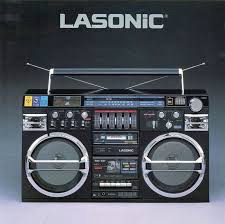
The Lasonic TRC-931. You didn’t carry this. You wore it.
At sixteen, I was earning $3.35 an hour at First Choice Discounts. My job? Hauling wooden palettes into a flooded basement. Backbreaking, nasty work. But it bought me the Lasonic TRC-931—the holy grail. Big, black, slot-loader deck, chrome edges that screamed “don’t touch me.” That thing ate D batteries like a crack habit and weighed more than my torso. I was so small, I literally handcuffed it to my wrist.
And when I finally strutted down Fordham with it, I was fully geared up in my motorcycle jacket—my second major purchase ever. Real leather. Bought from a hustler’s paradise on Delancey Street, after a half day of haggling like I was negotiating a hostage release. It was tough, creaky, and felt like armor. I imagined The Fonz would’ve nodded in approval if he ever came to the boogiedown.
My boots? Not so real. Fake motorcycle boots from Fayva—basically the Payless of the time. Pleather, loud soles, no arch support, but they looked the part. And at the time, looking the part was currency. You could walk crooked, as long as your swagger was straight.
I wasn’t exactly wearing the clothes of my peers and location. I was a Puerto Rican cosplaying a different time, and a different people. My love was the 50s.
So yeah, while the block was bumping Run-D.M.C., I was that weird rock kid blasting “Cry Little Sister” from The Lost Boys, in a real MC jacket, fake biker boots, and a boombox that felt like a trophy from another planet.
Economy of Hustle: How the Bronx Paid in Favors and Florsheims
Later I worked at a Hallmark store. The owners were this sweet, elderly couple who still believed in the power of a sympathy card. They took weekends off. And our Dominican manager? He had a system.
Turns out, the managers up and down Fordham Road had a barter ring. Weekends were the purge. You’d let the dude from the sneaker shop grab a pair of jeans, and he’d float you some Florsheims next week. I was the quiet kid, so to keep me from snitching, they cut me in. Suddenly I had Dr. Jay’s jeans, Florsheim shoes, even contact lenses from the eye place—all without paying a dime.
And Hallmark? That was its own kind of hookup. Girls would come in looking for cards for their trash boyfriends, and I’d help them pick one that said just enough. I came off introspective, soulful. A sensitive Bronx Cyrano. It didn’t hurt that I could slide them a free teddy bear or big ass Valentine’s heart if the vibe was right.
Shoplifters, Steel Gates, and Street Justice

You could hear the train before you saw it. And when you did, it was a moving mural of fear and defiance.
Retail in the Bronx? That was full-contact capitalism. When someone lifted something, we didn’t call security—we ran after ‘em. Through the store, into the street, sometimes into traffic. And if we caught them? Well… we caught them.
Sometimes we saw it coming. One of us would inch toward the gate switch. Wait for it. CLANK. Steel rolled down and trapped them inside the store with us. That sound wasn’t just a gate dropping—it was the bell for round one. Was it legal? Probably not. Did it work? Every damn time.
Breakbeats and Ninja Stars: Growing Up Between Eras
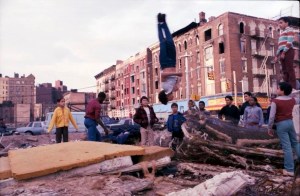
We made playgrounds out of nothing. The rhythm came from us.
Hip hop was bubbling up from the sidewalks. You heard it in clubs like The Devil’s Nest, drifting through Van Cortlandt Park, taped off the radio at 1 a.m.
One day, I ran into Grandmaster Flash walking through the woods in Van Cortlandt. No entourage. Just him and a few teens, blending in like it was just another afternoon. We stopped. Said what’s up. Kept moving. Didn’t fully register the moment until years later—how close we were to the roots of something massive.
Why were we even there? Because I was deep in my ninja phase. Throwing stars in the park, swinging questionable swords bought off Fordham vendors. Practicing stealth moves like the Bronx was feudal Japan.
And yeah, I took it too far. Once, some girls I knew got locked out of their apartment. Top floor. Only the top of the window was open. So I jumped from the fire escape and dove through like a low-rent Spider-Man. Saved the day. Landed on their carpet like a busted piñata. I was a hero. Looking back, it was an absolutely idiotic thing to do. But when you’re fifteen and trying to impress someone? Logic isn’t part of the loadout.
Ninja skillz for the ladies. Yeah…
Cardboard Kingdoms and Concrete Dance Floors
We practiced breakdancing on refrigerator boxes flattened on the street. Backspins, headspins, bruises, and pride. You didn’t need to be good. You just needed guts. And maybe a boombox that lasted long enough to finish the battle.

Me in the Bronx, mid-’80s. Somewhere between a car alarm and a boom box.
Rooftop Romance and Botanical Blunders
There was no privacy at home. So we improvised. Rooftops were our hotel rooms. Stairwells were our love shacks. Tar ruined shirts, but it was the cost of intimacy.
The bold ones snuck into the Botanical Garden. Quiet paths, hidden benches. One time I was under a sheet with a girl—mid-action—when a whole class of school kids marched past us like nature’s SWAT team. I’ve never redressed so fast in my life.
Dressed to Get Jumped: Fashion in a War Zone
Style in the Bronx was a full-contact sport. You didn’t wear clothes. You wore statements. And sometimes those statements got you stomped.
Lee jeans and Le Tigre polos were the uniform. But when V.I.M. ran a promo—bring in four Lee patches, get a free pair of jeans—it triggered chaos. Tough kids started ripping patches off anyone they thought wouldn’t fight back. If you had Lees but no patch? You were marked. A “punk-ass.” A victim.
(Apparently it wasn’t just my neighborhood. I found someone else writing about the exact same thing—turns out the Lee Patch Wars were citywide. VIM had us out here treating denim like contraband. Read it here.)
Then Run-D.M.C. made Adidas gospel. Everyone wanted shell toes—but not everyone had shell toe money. Enter the knockoffs: four stripes, weird tongues, and logos like “Abibas.” Kids would count your stripes. And if you had Skippies? Game over. You were done.
Real Adidas meant street cred—but only if you did it right. Your stripes had to match your Le Tigre. Bonus points if your Lees coordinated. That was the Bronx holy trinity of fit. And to top it off: splash of Cool Water or Drakkar Noir. Maybe a Kangol if you had the nerve. Confidence in cotton.
But one rule. One unbreakable, universally understood Bronx law: never use shoe polish on your sneakers. One chalky white mark on your Adidas and the jig was up. You weren’t fresh—you were trying too hard. And trying too hard could get you roasted and robbed.
Final Thoughts: We Were the Beat in the Broken
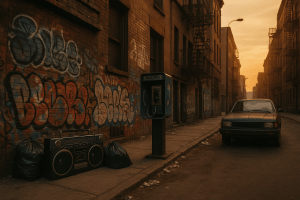
This was our orchestra pit. We just needed to survive long enough to write the score.
We didn’t have much—but we had the Bronx. The 4 train, the rooftop makeouts, the mixtapes, the muscle memory of dodging, chasing, and surviving. We were broke, weird, brave, smelly, stylish, romantic, and ridiculous.
And somehow, that was enough.
We didn’t just survive the Bronx in the ’80s. We lived it loud.
1983 to 1989. Right there in the fire, before it all went digital.
Thank you for reading.
The Bronx made me sharp, but the island made me whole.
If you want to see where it all started — the mango trees, the brujería, the bunny that didn’t make it — head back to Puerto Rico: Soy Boricua. Soy GenX. Así Fue Pa’ Mí.
Or rewind to the moment Star Wars rewired my little latchkey brain: Greedo Was My First
Discover more from Genex Geek
Subscribe to get the latest posts sent to your email.
 Genex Geek
Comment like it’s a middle school slam book, but nicer.