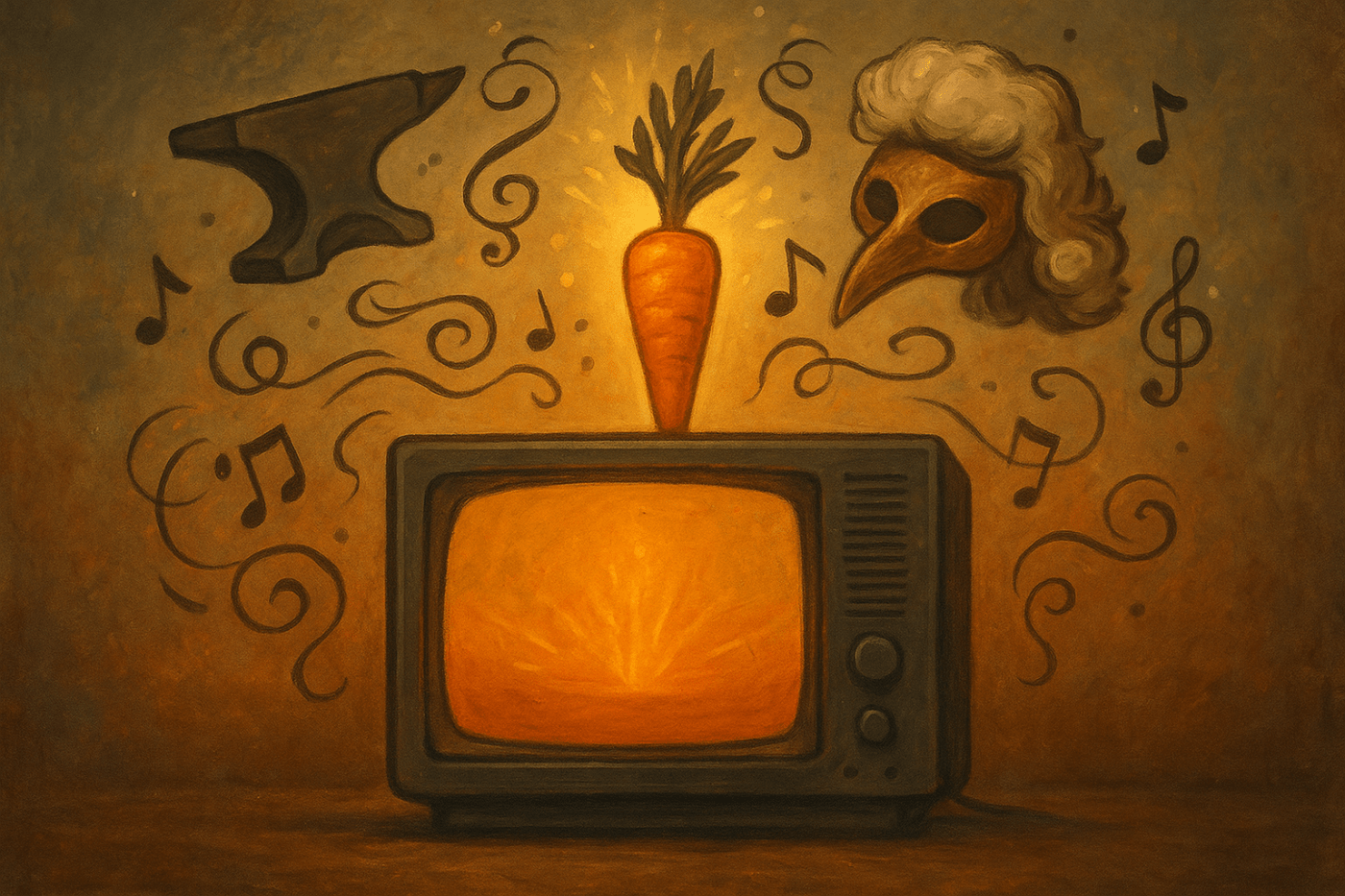
My Homage to the Rabbit

There are gods who shape the world with thunder.
There are gods who whisper the laws of order.
And then there’s Bugs Bunny, who rewrites reality with a Brooklyn accent and a carrot.
He does not ask for worship.
He doesn’t sit upon a throne.
He digs a hole, pops out wherever he pleases, and asks the cosmos,
“Eh… what’s up, Doc?”
To those of us who grew up with TV trays and sugary cereal, Bugs wasn’t just a cartoon.
He was the first god we understood. Unpredictable, untouchable, and armed with the sacred gift of mockery.
He is not a hero. He is not a villain.
He is the Trickster.
Not chaos for its own sake, but chaos with a smirk.
A divine reminder that the universe takes itself way too seriously.
The Theory
He is not a rabbit. He is an idea.
You can call him a cartoon if you want, but you’re underestimating him.
Bugs Bunny is not bound by genre, logic, or physics. He is the sovereign deity of animated chaos, and his true power lies in the fact that he knows it.
He is meta before meta was a concept.
Fourth wall? He taps it like a fish tank.
Continuity? Optional.
Time? Relative.
Death? Reversible with a smirk.
He is not the God of Mischief. He is the God of Mastery — over tone, tension, and tempo.
Marvel’s Loki wishes he had this kind of omnipotence.
Loki fakes his death. Bugs fakes being a horse’s ass, a Valkyrie, a barbershop quartet, a ghost, and a game show host — all in the same scene — and wins.
Loki starts wars. Bugs wins them with a banana peel and a “Nyeh.”
“What’s up, Doc?” isn’t just a catchphrase. It’s a divine incantation,
the calm before reality collapses into whatever he needs it to be.
Bugs doesn’t play by the rules of narrative. He rewrites them in real time.
His only allegiance is to the laugh. And the laugh is sacred.
He embodies the trickster god archetype found in every mythological system:
- Loki weaponized wit, but often got caught in his own traps. Bugs never does.
- Coyote used chaos to teach lessons. Bugs is the lesson.
- Anansi spun webs of deceit. Bugs doesn’t need webs. He just points, grins, and lets you fall in your own hole.
He is chaos refined into elegance.
He is the joke told by the universe at the expense of anyone who takes themselves too seriously.
He is your punishment for being arrogant.
He is your reward for paying attention.
The Feats

The scriptures are animated.
The miracles, broadcast in Technicolor.
And every Saturday morning, we bore witness.
Bugs Bunny’s mythology wasn’t carved into stone. It was burned into our memory by TV cathode rays and the sounds of anvils, Wagner, and confused ducks getting shot in the face.
Every episode was a parable.
Every confrontation, a ritual.
Every victory, inevitable.
Let us now remember the sacred texts.
Duck Season / Rabbit Season
(“Rabbit Fire,” 1951)
This is not just a cartoon. This is linguistic warfare.
Elmer Fudd wants to hunt. Daffy Duck wants Bugs dead.
Bugs doesn’t argue. He simply redirects the entire flow of language until his enemies walk themselves into annihilation.
He manipulates syntax like a spellcaster. He weaponizes punctuation. He makes “pronoun trouble” into a death sentence.
By the end, Daffy’s been shot so many times he sounds like a malfunctioning foghorn.
Bugs hasn’t moved an inch — except to smile.
Rabbit of Seville
(1950)
Bugs doesn’t hijack the narrative. He hijacks theater itself.
While Elmer chases him into an opera house, Bugs rises from the orchestra pit like Mephistopheles in drag. He shaves Elmer bald, slaps on makeup, and matches Rossini’s overture beat-for-beat like a chaos conductor.
It’s not a fight. It’s a performance.
It’s not survival. It’s domination, choreographed in slapstick.
He doesn’t escape danger.
He turns it into a musical number.
What’s Opera, Doc?
(1957)
The gods tried to warn us.
In this seven-minute epic, Bugs becomes Brünnhilde.
He dons drag, sings Wagner, seduces his hunter — then dies. Dramatically. Tragically.
Only to wink at the audience with a single line:
“Well, what did you expect in an opera?”
It’s the Looney Tunes Passion Play.
Death as punchline.
High art defiled — and improved — by one rabbit in a horned helmet and heels.
Bully for Bugs
(1953)
A bullfight. A misunderstanding. And a warning:
“I knew I shoulda taken that left turn at Albuquerque.”
What follows is a dismantling of masculinity itself.
Bugs doesn’t just defeat the bull. He clowns it. Dresses it up. Traps it in its own momentum. Wears its skin, its pride, its rage like a costume.
He doesn’t fight like a warrior.
He wins like a myth — by making the battle ridiculous.
Super-Rabbit
(1943)
Even Superman kneels before the rabbit.
In this wartime satire, Bugs becomes a superhero. He mocks the genre, the military, and nationalism itself — then joins the Marines.
Why?
Because he can. Because the bit demands it. Because reality is a prop, and he’s the only one holding the script.
Each episode is a relic.
Each role, a mask.
Each mask, a lesson.
Power doesn’t always punch. Sometimes it flirts, sings, and rearranges your atoms with a pun.
The Meaning

Bugs Bunny wasn’t a role model. He was a reminder.
That survival wasn’t always noble.
That clever beat strong.
That laughter was a weapon — and sometimes, your only one.
He didn’t ask us to be good.
He asked us to be sharp.
To never let the bully think he had the upper hand.
To win by refusing to play their game.
And to look fabulous doing it.
Bugs didn’t fight for a cause.
He fought for style.
For revenge.
For the absurd right to outwit someone with a pie, a pun, or a pair of heels.
For Gen X, he was holy mischief wrapped in Technicolor. The chaos spirit who dropped into our living rooms on Saturdays and taught us to never take authority too seriously.
Not the school principal.
Not the government.
Not the genre.
Not the gods.
And not ourselves.
“What’s up, Doc?” wasn’t just a greeting.
It was a sacred challenge.
A trickster’s prayer.
A reminder that anyone who messes with you might just get their soul rearranged by a rabbit with a Brooklyn accent and access to higher narrative planes.
We didn’t watch Bugs to relax.
We watched to remember.
That the world might be rigged.
That the rules might be stupid.
But that if you’re smart enough, fast enough, funny enough — you could still win.
And you’d get the last line.
Bugs wasn’t alone on the mountaintop.
If he was the Trickster God of Saturday mornings, then others filled out the pantheon — silent jazz spirits, fallen titans, and animated deities who shaped us more than we realized.
You can meet his cosmic counterpart in The Pink Panther: The Silent God of Benevolent Entropy,
and mourn the others we lost in They Raised Us Too: The Cartoon Gods We Lost.
Together, they built our mythology — and maybe saved our sanity.
Discover more from Genex Geek
Subscribe to get the latest posts sent to your email.
 Genex Geek
I want to thank you for writing something so full of truth and grace. Your post lifted my heart and reminded me of the power of faith-filled words. You write with such ease, yet your message carries great depth. It’s beautiful. I’m already looking forward to more! May the Lord bless your writing with continued clarity, purpose, and encouragement. Stay faithful in your calling. He has equipped you to reach others in ways only you can. Keep pressing on with courage, knowing that your words are touching lives and pointing hearts toward Him. Don’t grow weary—you’re doing His work.
LikeLike
Bugs Bunny is family. The world could sure use more of his presence right now.
LikeLike